

How long does it take to be ISO 27001 certified?
Even for small companies, achieving ISO 27001 certification can be a significant project that typically takes between 3 to 8 months. This guide breaks down the timeline into clear phases so you know exactly what to expect.
Key Takeaways
- Expect a 3 to 8-month journey: For most small to medium-sized businesses, the entire ISO 27001 certification process from start to finish takes about 3 to 8 months.
- Size and complexity matter: The timeline can be shorter (2-4 months) for very small, agile startups with a simple tech stack, but it extend beyond a year for larger or more complex organizations.
- It’s a phased project: The process is not a single sprint. It’s a structured project with distinct phases toward compliance, including scoping, risk assessment, implementation, and the final audits.
Breaking down the ISO 27001 timeline
The path to ISO 27001 certification is a marathon, not a sprint. It’s best understood as a project with several key milestones or phases.
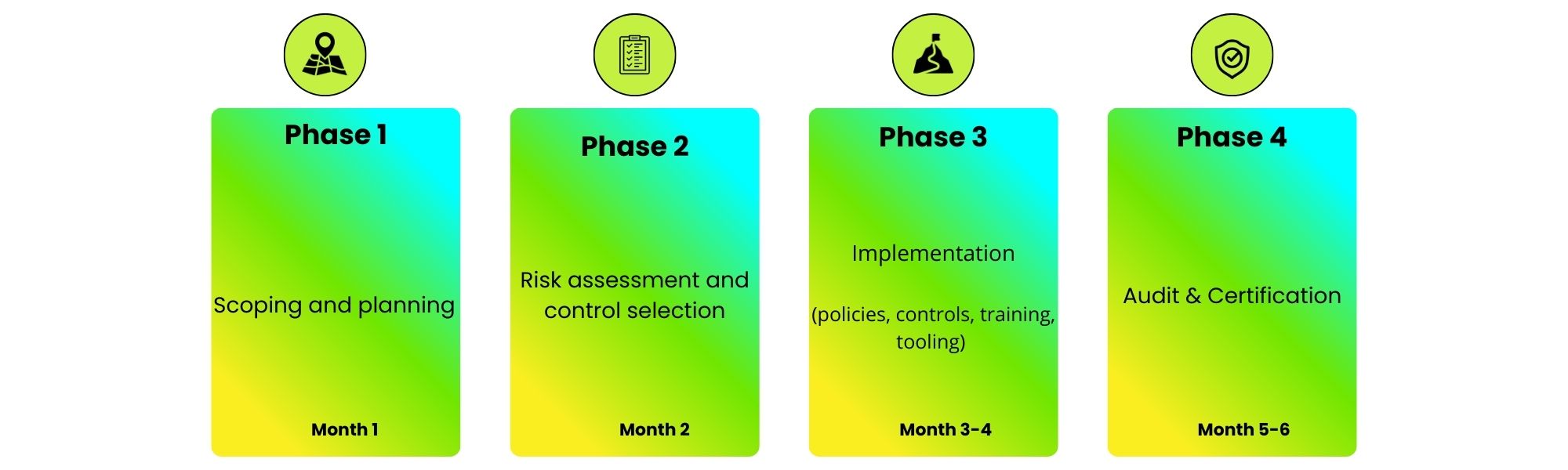
Phase 1: Scoping and planning (month 1)
This is the foundational stage where you define the scope of your Information Security Management System (ISMS). You’ll decide which parts of your business, which products, and which offices will be covered by the certification. It involves having everyone aligned and defining a clear owner (else it won’t move).
Phase 2: Risk assessment and control selection (month 1)
This is the core of the ISO 27001 process. Your team will conduct a formal risk assessment to identify threats and vulnerabilities to your information assets. Based on this assessment, you’ll select the appropriate security controls from ISO 27001’s Annex A to mitigate those risks. This phase requires proper documentation.
Phase 3: Implementation (month 2-4)
This is often the longest and most resource-intensive phase. Here, you put the selected controls and policies into action. This involves everything from writing new security policies and training your staff to implementing technical controls like access management and data encryption. Some organizations also choose to conduct a penetration test during this phase to validate their technical controls.
Phase 4: Audits and certification (months 5-6)
Once your ISMS is fully implemented and has been operating for a period, you can start the audits:
- Internal audit (blank): The auditor verifies that the ISMS documentation is appropriately designed and effectively implemented and maintained in practice.
- Certification audit:
- Stage 1 audit: The auditor reviews your documentation to ensure your ISMS is designed correctly.
- Stage 2 audit: The auditor conducts a deeper dive, reviewing evidence and interviewing your team to ensure your ISMS is fully implemented and effective.
Usually, people keep at least 15 days between Stage 1 and Stage 2 to fix potential issues raised by their auditor.
How Probo accelerates the ISO 27001 timeline
The traditional 3 to 8-month timeline is a significant commitment that drains a startup’s most valuable resources: time and engineering focus. Probo was built to fix this. We act as an internal compliance officer would. We transform the long, manual process into a fast, expert-led service.
- We do the heavy lifting for you: Instead of your team spending weeks learning the standard, we manage the entire process for you. We handle the most complex parts, like conducting the formal risk assessment, selecting the right controls, and creating all the required documentation (policies, procedures) tailored to your business.
- We free up your engineers: The implementation phase can pull your technical team away from their core tasks. We give your team a practical, prioritized checklist of only the necessary and relevant security controls. This means they can stay focused on building your product, not on becoming compliance experts.
- We manage the audit: Our expert team acts as your dedicated compliance team during the audit process. We prepare the evidence, manage communications with the auditor, and ensure the entire process runs smoothly and efficiently. You will still exchange with the auditor as it is part of their job to talk with you: he/she evaluates your company.
Conclusion
The traditional 3 to 8-month path to ISO 27001 certification is a major roadblock for startups trying to move fast and win global customers. This is the problem Probo’s expert-led, “done-for-you” service was built to solve. We replace the long, manual process with a fast, tailored program, handling everything from risk assessment to managing the final audit. We save your team hundreds of hours and allow you to build trust with international customers faster. Then, we help you maintain everything continuously so it is not a burden.
Frequently asked questions
1. Can we get ISO 27001 certified in less than 6 months?
It’s possible for small companies with a simple tech stack and some existing security controls, but it’s an ambitious timeline. The process requires careful documentation and time for the implemented controls to become operational before the final audit.
2. What is the hardest part of the ISO 27001 process?
For most startups, the risk assessment and implementation phases (Phases 2 and 3) are the most challenging. The risk assessment requires a specific methodology that can be unfamiliar, and implementing dozens of new policies and controls can be a heavy lift for a small team.
3. Do we need a dedicated person to manage the ISO 27001 project?
Yes, you will need a dedicated project lead. However, this person doesn’t have to be a full-time compliance expert. In small companies, it is usually the CEO or the CTO. Many startups have found success by partnering with a compliance team like us which acts as your dedicated compliance team, managing the project during implementation, streamlining the audit and running your ISMS documentation for you. See how Lucis achieved their ISO 27001 certification with this approach.
4. What happens after we get certified?
ISO 27001 is not a one-time event. After your initial certification, you will have annual surveillance audits to ensure you are maintaining and continually improving your ISMS.

You're subscribed — thanks for signing up!